
Quotation within one business day. COA and SDS with every lot.
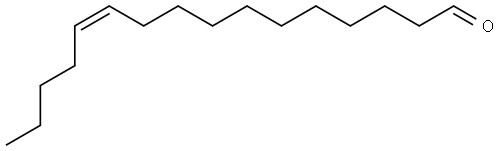
(Z)-11-Hexadecenal (CAS 53939-28-9): aldehyde for fast-releasing monitoring lures, with the isomeric form and packing agreed per order and COA and SDS on every lot.
A sixteen-carbon aldehyde with the double bond at C11. Aldehydes are the reactive end of a lure blend: the carbonyl oxidises in air, so the material ages from the moment a container is opened, and the practical shelf life is set by how well oxygen and light are excluded rather than by the assay at release. The first reply covers specification, packing and the batch window, because those three decide whether the order moves.
| CAS number | 53939-28-9 |
|---|---|
| Molecular formula | C16H30O |
| Molecular weight | 238.41 g/mol |
| Isomeric form | (Z) |
| Standard packing | 1kg / 25kg / 100kg |
| Documentation | COA and SDS with every lot |
| Quote basis | Per lot, specification agreed before dispatch |
A conjugated aldehyde, chemically
The carbonyl at the end of the chain makes this a reactive molecule: it oxidises to the corresponding acid in air and it participates in the addition reactions that a formulator has to keep away from. That reactivity is exactly why the compound works at very low load, and why it is the first component in a blend to show its age.
Stability in storage and on the dispenser
Light, oxygen and trace metals are the three things to exclude. Sealed containers with limited headspace, dark storage and a clean dispenser matrix extend useful life; a partly used drum left open in a warm room does not. If catch drops late in the season, the aldehyde has usually gone before the carrier has.
What the analytics have to show
Identity and isomeric ratio are the two parameters that decide whether the lot will behave like the last one. An assay figure on its own is not enough for an aldehyde, because a material can be 97% pure and still be the wrong isomer.
Where this compound sits in a blend
Most blends use one component to set the ratio and two or three to trim it. Which role a given compound plays is a property of the target rather than of the chemistry, so the same material can be central in one blend and marginal in another.
Isomeric form
Isomeric purity is quoted as a ratio, not as a main-peak percentage, because the neighbouring isomer is the number that moves a blend. This entry is the (Z) form. The lot is released against that descriptor, and the ratio of the named isomer to its partner is stated on the certificate.
Load rate and blend position
Dose per hectare, per trap or per dispenser is your calculation. What we commit to is the composition of the material that goes into it.
Packing and lot size
Fills are 1kg / 25kg / 100kg. Bulk filling, split lots and customer-labelled units are handled as part of the order instead of as exceptions afterwards.
Documentation
Specification sheet, COA and SDS are issued together, and all three carry the same lot number for filing.
Ordering
Quotations carry a validity period, since campaign and raw-material costs move. If one has expired, ask for a reissue rather than assuming the old figure.
From trial lot to production lot
The first commercial order normally repeats the trial quantity. That is deliberate: it separates a scale-up problem from a formulation problem before a full batch is committed.
What the analytical package covers
The package we issue covers assay, isomeric ratio and identity. A full impurity profile is not included unless it is asked for, because the useful impurities depend on the route and on what your own specification limits.
Release rate and dispenser matching
On a passive dispenser the active has to leave the matrix at a rate the insect can follow. That is a formulation property, which is why load rates are not transferable between dispenser types without field confirmation.
Registration and destination paperwork
For research quantities the paperwork is lighter than for commercial volume, but it is not absent. Ask before the order, not after the invoice.
Compatibility with carriers and dispensers
The carrier decides how much of the active is available at the surface. Rubber and polymer matrices hold a lipophilic compound longer than a liquid formulation does, and a highly volatile active will leave a thin matrix well before the season ends.
Questions buyers ask about this CAS
- Can the packing be changed from 1kg / 25kg / 100kg?
- Usually, where the order supports it. Smaller fills are quoted with the packing cost shown separately, and customer-labelled units are handled as part of the order rather than as an exception afterwards.
- How is the isomeric form fixed for CAS 53939-28-9?
- It is written into the release specification and reported on the certificate. Where the name already carries a stereodescriptor — as this one does — matching that descriptor is the first condition of the release.
- Do you supply outside fast-releasing monitoring lures?
- The same material is quoted for any application where the specification can be met. If the intended use has a documentation requirement attached to it, that is worth stating at enquiry stage so the paperwork can be planned in advance.
- What is the usual first-order route?
- A specification exchange, then a trial lot, then a commercial batch at the trial quantity before scaling. Each step is quoted, and none of them commits the customer to the next.
Handling and storage
Handle in a ventilated area with standard laboratory protection. The material is sold for professional use, not for repacking into consumer products.
Request a quotation for (Z)-11-Hexadecenal
The CAS number and the compound name are already filled in. Add the quantity, the packing you want and the destination, and the reply comes back with a specification against it.